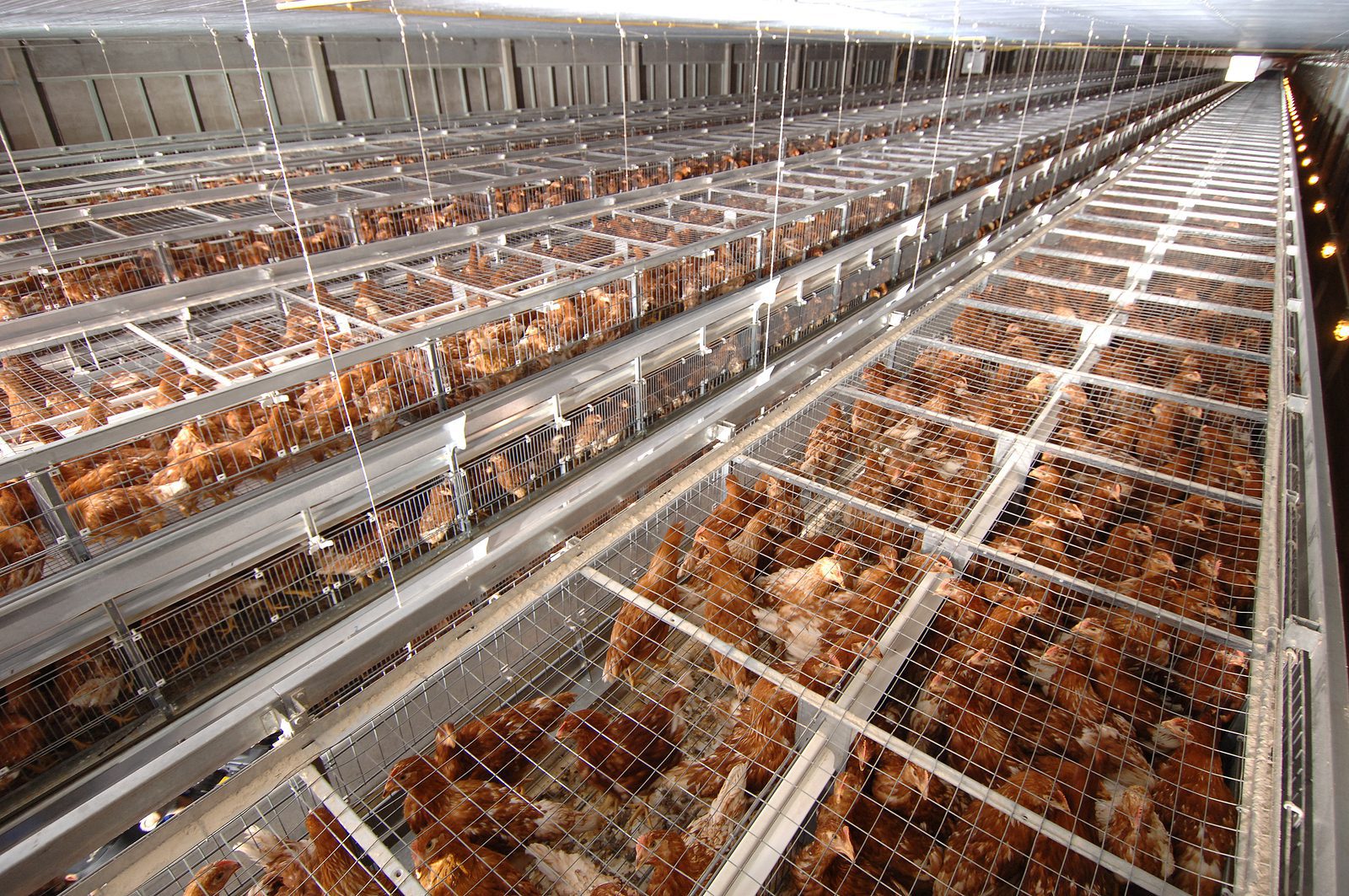
Typical battery cages containing hens in a factory farm
Welfarism and abolitionism are often seen as two diametrically opposed philosophies in vegan activism. Welfarism, to most, is the strategy of securing welfare improvements for farmed animals (e.g. fighting battery cages for hens or gestation crates for sows), while abolitionism is the strategy of advocating for total animal liberation. This generally takes the form of vegan outreach, a method that aims to create new vegans through social media posts, flyers, posters, and public events like tabling and cubes. For most people, abolitionism means promoting only true ethical veganism, a philosophy which completely rejects the commodification of animals in any scenario. These two frameworks for activism have prompted plenty of debate in the world of animal activism, which has led to a great deal of animosity between proponents of either style. The terms “welfarism” and “abolitionism” are themselves misleading; for most activists engaging in welfare campaigns, the ultimate goal is still total animal liberation, yet the framing of welfarism as a distinct ideology from abolitionism suggests that improved welfare is the goal, not the abolition of animal exploitation. Some activists, of course, are only interested in securing improved welfare for farmed animals, but modern welfare campaigns are organized and carried out by vegans who want nothing more than a vegan world.
Why are welfare campaigns necessary?
While vegan outreach is very effective at changing individual behaviors, years of outreach have struggled to move the needle with regards to the number of vegans in the United States, and the consumption of animal products only continues to rise. The number of eggs produced in the United States reached nearly 45 billion dozen in 2024, up from around 37 billion dozen in 2004. It’s entirely possible that public outreach has prevented even further growth, and per capita consumption has remained fairly stable over that period, but the fact of the matter is that we are still moving in the wrong direction. Something more needs to be done, and fast.
But if the goal is a vegan world, why are vegans fighting for cage-free eggs? On the surface, anti-cage campaigns might seem like a half-measure for vegans who supposedly want to end egg production entirely. Cage-free eggs only solve one of the problems of egg production without getting at the root of the problem. Cage-free hens are still kept in overcrowded sheds, are selectively bred to produce thirty times as many eggs as their wild ancestors without any regard to the strain it places on their bodies, and are still valued only for their eggs and are hence slaughtered the moment their production drops. The life of an egg-laying hen is miserable from the moment she hatches, and the suffering only ends when she meets an untimely death hanging upside down in a slaughterhouse. If we could end these horrors with pressure campaigns and lobbying, we would do it immediately. However, this isn’t the world we live in. At least 95% of the United States sees no problem with any of this (or at least doesn’t care enough to do anything about it), and eggs will continue to be a staple of American grocery stores for the foreseeable future. Demanding an end to egg farming is, for most, a very radical position, and one that few are willing to accept at this point in time. As a movement, we do not currently have the power to demand such a radical change in a short period of time. A campaign against a major corporation like Kroger or Ahold Delhaize (parent company of Food Lion) demanding an end to egg sales would be met with equal parts ridicule and repression; neither company would ever remove such a staple item from their shelves in response to pressure from what they (and the general public) see as fringe activists. Hens are going to be bred and exploited regardless of what we do, so we need to use our power strategically to secure better lives for them. Cage-free campaigns are something that we can win today, and even though they might not stop egg production, they make a world of difference to the hens who, thanks to us, will no longer spend their lives confined with six of their brethren to a cage the size of a piece of printer paper.
The same logic applies to other types of welfare campaigns, where banning things like gestation crates for sows or mutant chicken breeds create real, meaningful improvements in the lives of billions of animals. Even though we don’t have the strength to demand radical change from governments and corporations, we have a surprising amount of power to fight the worst abuses of animal agriculture. Pressure campaigns against corporations have been enormously successful: through the work of a few hundred activists worldwide, multi-billion-dollar companies like Costco and Ahold Delhaize have committed to going 100% cage-free, and the dominoes continue to fall. With enough motivation and strategy, these campaigns are almost always winnable. And these commitments are no small thing—each one can mean improving the lives of hundreds of millions of hens. As an individual, these campaigns are arguably the single most impactful thing you can do to help animals.
How does this lead to a vegan world?
Although these victories might seem energizing, it isn’t necessarily obvious how this leads to animal liberation. Even if we can spare animals from the worst abuses, they will nevertheless continue being exploited until we can get at the root of the problem. Staunch abolitionists often take issue with welfare campaigns for precisely this reason, arguing that these measures are insufficient for protecting animals. Their disapproval is understandable, but misguided. It is better to frame cage-free campaigns, for example, as anti-cage; we should never aim to promote egg consumption, but rather to oppose the worst practices of the industry. If a human were being abused and you were powerless to save them, fighting to at least improve their comfort could hardly be considered an endorsement of their abuse. Welfare campaigns should rather be understood as the first step towards the end of animal exploitation, where we use our power strategically to reach the low-hanging fruit. We can reach these low-hanging fruit because they are the worst and most obvious offenses, and so it appears reasonable to oppose them. In a world where battery cages have been outlawed, suddenly mutant chicken breeds or male chick culling are the most outrageous offenses of the egg industry, and campaigns against those can have the same successes as the anti-cage campaigns of today. With each successive win, we chip away at the industry and make it harder, more expensive, and riskier to farm animals until the whole idea becomes unpalatable altogether. At the same time, the public begins to understand animals as beings who can suffer and whose needs must be genuinely considered, which creates a fertile environment for veganism to grow.
Although it may be frustrating to be forced to expend so much effort on fighting over what seem like minor details in the massive system of animal agriculture, these small steps are necessary to build our power as a movement and eventually break down the system. Fighting for incremental changes isn’t the same as endorsing their outcome; strategic decisions are not moral ones.
The importance of wins
It’s no secret that the animal rights movement can be a depressing environment at times. We are a few thousand people up against a trillion-dollar industry that 95% of the world supports. Every vegan knows the frustration of trying to get family and friends to understand why they are vegan; it feels like nobody else cares about the enormous issue that’s staring them right in the face, and no amount of persuading will get them to do anything about it. Good outreach can do a lot to get strangers to change their minds, but the impact is remote and difficult to measure. It’s no surprise, then, that this movement has an incredible amount of burn-out and turnover as activists become frustrated with the progress and begin to feel hopeless. Welfare campaigns, however, are routinely winnable, and progress is being made all the time. It’s easy to feel motivated when your movement is on a roll, when every action you take matters. These campaigns are necessary to keep the movement going and to inspire new activists to get involved.